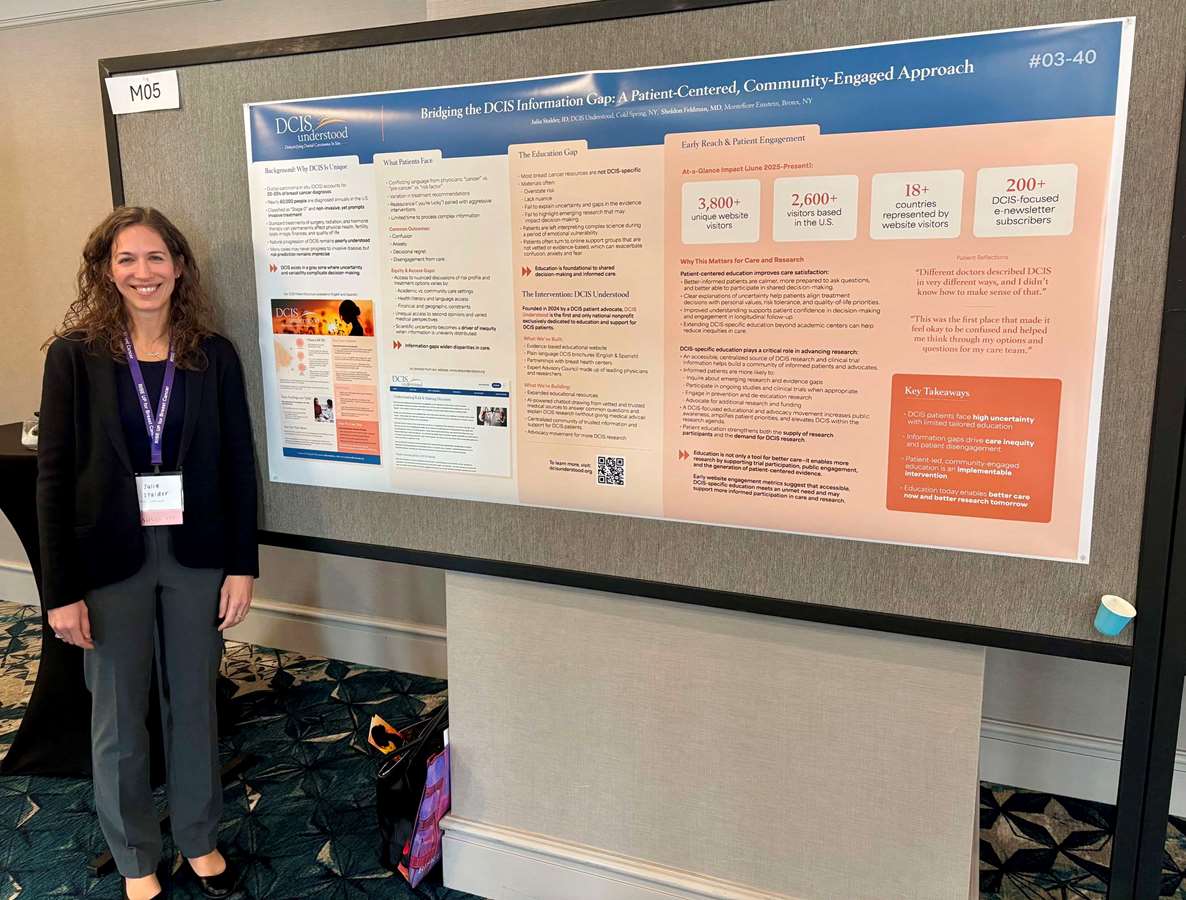
Last week, DCIS Understood had the honor of attending—and presenting at—the RISE UP (Revolutionizing Investigations to StEp Up Prevention) for Breast Cancer and Women’s Health conference hosted by UCSF.
RISE UP is not a typical breast cancer conference. Its focus extends beyond treatment into prevention, early intervention, equity, innovation, and women’s health more broadly. The unifying message throughout the program was clear: we must think earlier, think differently, and think more holistically about breast cancer care.
That framing could not be more relevant to DCIS.
We were especially proud that DCIS Understood was selected to present a poster at the conference. Our poster summarizes:
- Why DCIS is uniquely challenging
- The education and equity gaps patients face
- What we’ve built so far
- What we are actively working toward
- Why education is foundational to both better care and better research
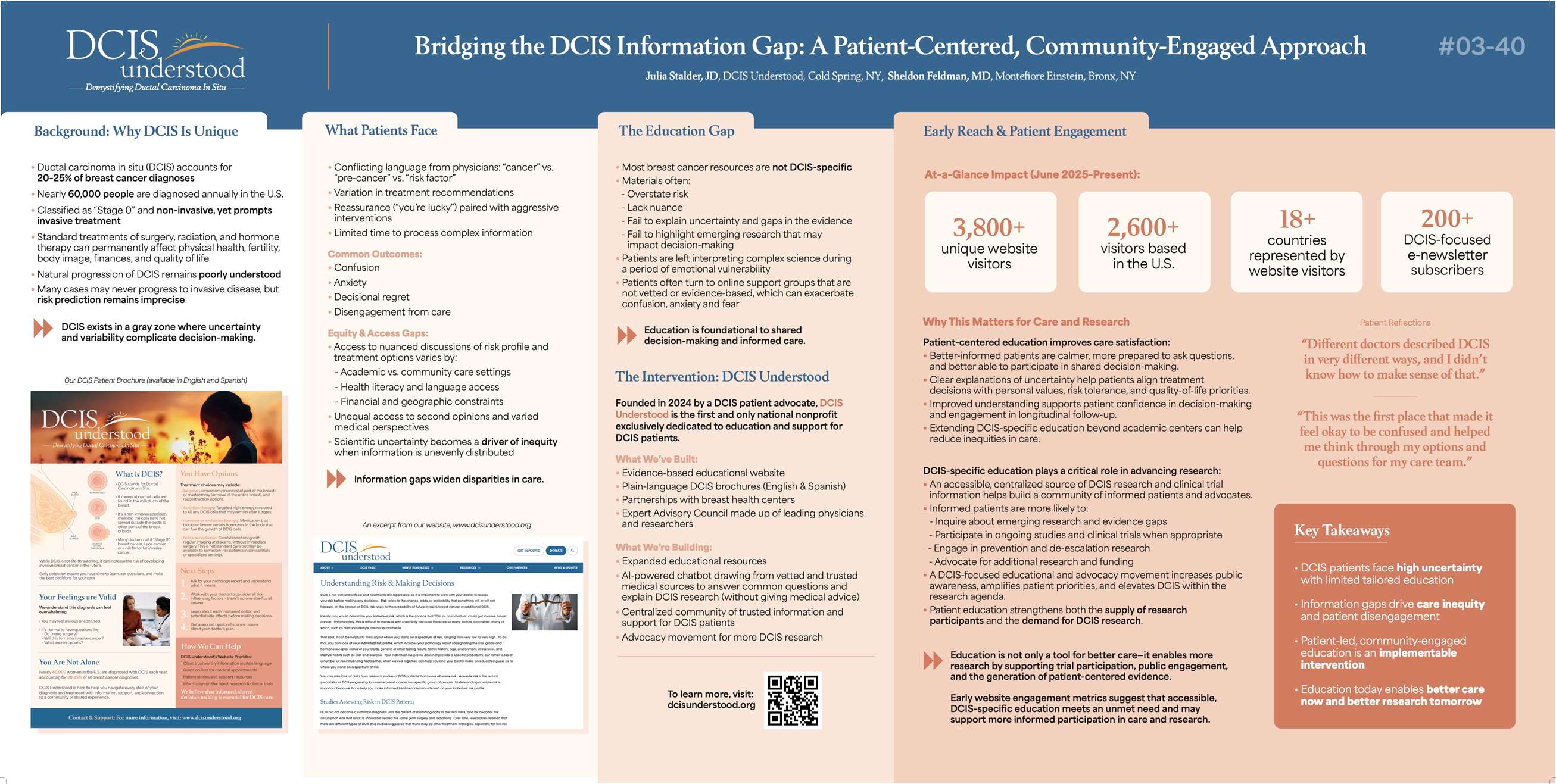
Bridging the DCIS Information Gap: A Patient-Centered, Community-Engaged Approach
Download a PDF of the DCIS Bridging the Information Gap Poster
DCIS Lives at the Intersection of Prevention and Treatment
One of the most powerful themes of RISE UP was the call to shift attention upstream — toward prevention, risk reduction, and intercepting disease earlier.
DCIS occupies exactly that space.
As highlighted in our poster
- DCIS accounts for 20–25% of breast cancer diagnoses
- It is classified as Stage 0 and non-invasive
- Its natural progression remains poorly understood
- Many cases may never progress, yet risk prediction is imprecise
DCIS exists in a gray zone. It is biologically non-invasive at diagnosis, yet it often triggers invasive treatment. It represents both an opportunity for prevention and a source of uncertainty.
If we are serious about rethinking breast cancer care, DCIS must be part of that conversation.
Thinking Outside the Box Means Rethinking Information
Another core theme of the conference was innovation — not only in therapeutics, but in care delivery, communication, and systems design.
Our poster argues that education itself is an intervention
Today, many DCIS patients face:
- Conflicting language (“cancer” vs. “pre-cancer” vs. “risk factor”)
- Variation in treatment recommendations
- Limited time to process complex science
- Materials that overstate risk or fail to explain uncertainty
- Unequal access to nuanced discussions depending on care setting
When information is unevenly distributed, uncertainty becomes a driver of inequity.
Prevention is not only about biology. It is also about preventing confusion, preventing unnecessary fear, preventing decisional regret, and preventing disengagement from care.
At DCIS Understood, we are working to address this through:
- An evidence-based educational website
- Plain-language brochures in English and Spanish
- Partnerships with breast health centers
- An expert Advisory Council
- Expanded resources and an AI-powered chatbot grounded in vetted medical sources
Education strengthens shared decision-making today and supports research participation tomorrow.
Prevention Requires Informed Patients
A recurring message at RISE UP was that prevention and de-escalation research require partnership with patients.
Our poster emphasizes that accessible, centralized DCIS education can:
- Support more informed trial participation
- Increase engagement in prevention and de-escalation studies
- Amplify patient priorities within the research agenda
Education builds both the supply of research participants and the demand for better research.
If we want to intercept disease earlier and tailor care more precisely, patients must understand the evolving science — including its uncertainties.
Why This Moment Matters
Being part of RISE UP affirmed something we see every day in the DCIS community:
Patients are ready for more nuanced conversations.
Researchers are asking better questions.
Clinicians are increasingly open to individualized approaches.
But systems do not change automatically.
DCIS is often described as “Stage 0,” yet the experience of navigating it can feel anything but minimal. When we invest in DCIS-specific education, we are not just clarifying terminology. We are building infrastructure for better prevention science, better equity, and better long-term outcomes.
RISE UP challenged all of us to think bigger about what is possible in breast cancer and women’s health. We left energized by the innovation, the cross-disciplinary collaboration, and the growing recognition that prevention and patient voice must be central—not peripheral—to the future of care.
Looking Ahead
DCIS Understood will continue to:
- Expand accessible, evidence-based DCIS education
- Elevate patient voices in research and clinical conversations
- Advocate for more prevention-focused and de-escalation research
- Work toward a future where uncertainty is acknowledged transparently, not obscured
If we are going to think outside the box in breast cancer, we must include DCIS in that reimagining.
We are grateful to the RISE UP community for the opportunity to contribute to that conversation — and grateful to the DCIS patients and partners who make this work possible.
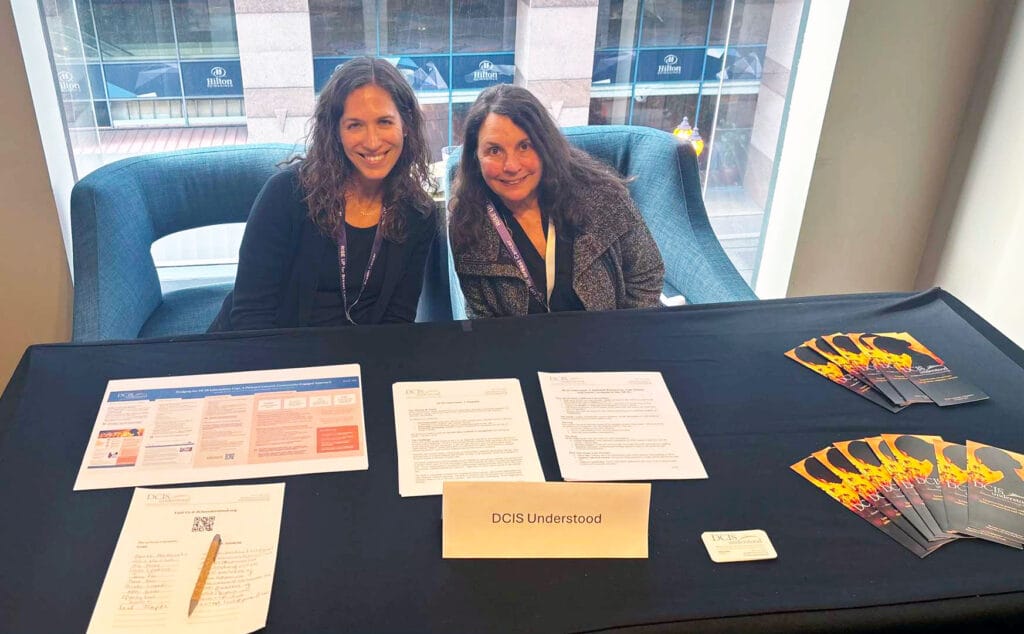
DCIS Understood Founder, Julia Stalder and volunteer, Desiree Basila, at our expo table
Subscribe below for the latest DCIS news and updates.