
Why Does Some DCIS Become Invasive Breast Cancer? New Research Offers Clues
If you’ve been diagnosed with ductal carcinoma in situ (DCIS), you may be wondering: Will my DCIS become invasive breast cancer? It’s one of the most important questions in DCIS care, and right now no one can predict with certainty how an individual case will behave.
A new study published October 20, 2026, in Cell Reports Medicine offers an intriguing clue. It suggests the immune system may help decide whether DCIS stays contained within the milk ducts.
Researchers at McGill University’s Rosalind and Morris Goodman Cancer Institute, working with a collaborator at MD Anderson Cancer Center, found that a type of immune cell may help weaken the protective barrier around the milk ducts. Their findings also suggest a possible way to prevent that damage.
This is early-stage research, largely conducted in mice, and it does not change how DCIS is treated today. But it’s a meaningful step toward a goal we care about deeply: understanding which DCIS needs treatment and which may not.
What Keeps DCIS from Becoming Invasive?
In situ means “in its original place.” In DCIS, abnormal cells are found inside the milk ducts but haven’t spread into the surrounding breast tissue.
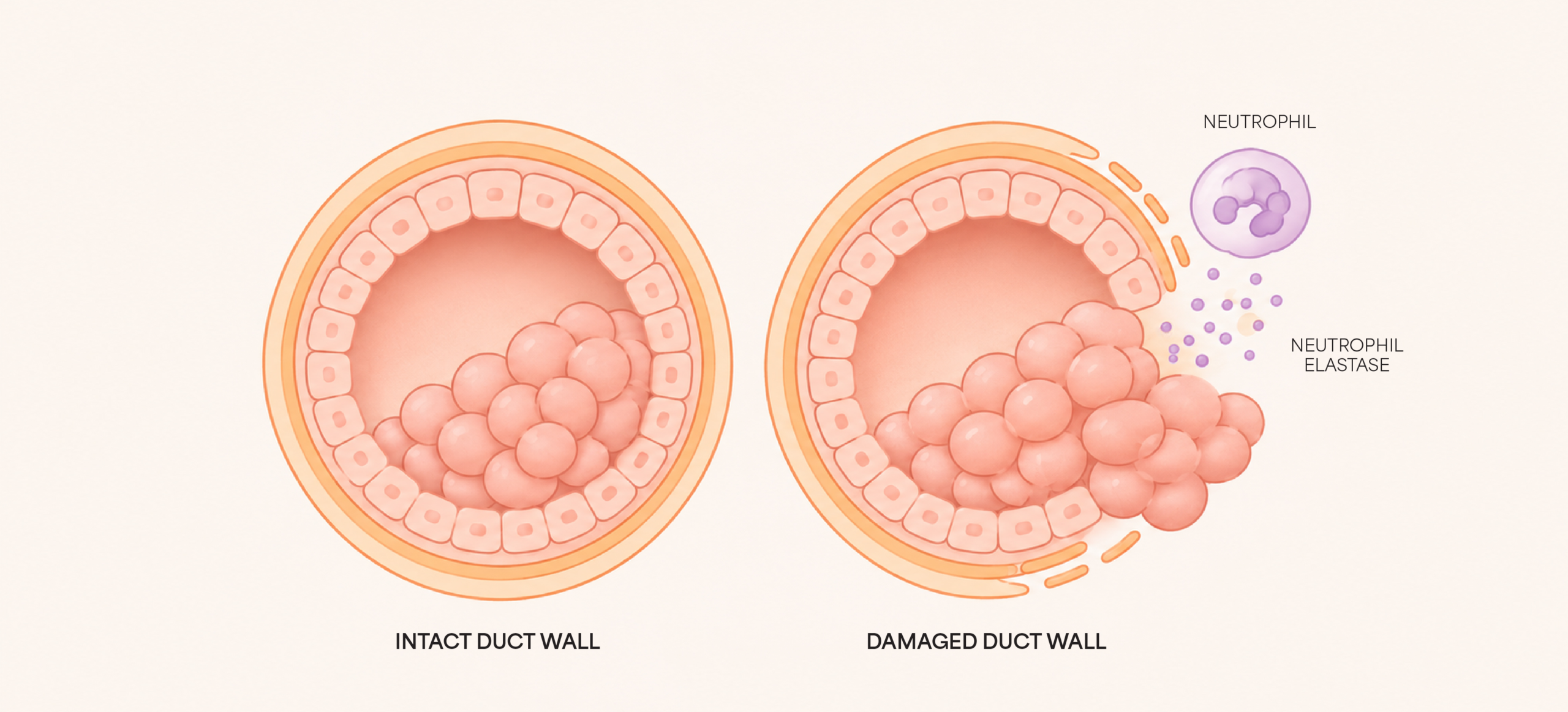
What keeps them contained? Each milk duct is wrapped in a protective outer layer of cells called the myoepithelial layer. That layer sits on a thin, sheet-like supporting structure called the basement membrane. Together, they act like the walls of a pipe. As long as that wall stays intact, the condition remains DCIS. If it breaks down, abnormal cells can move into the surrounding breast tissue.
Scientists have long known this barrier matters. What they haven’t fully understood is what causes it to break down.
Learn more about DCIS and what your diagnosis means.
How the Immune System May Influence DCIS Progression
The new study focused on neutrophils, the most common type of white blood cell. Neutrophils are first responders: they rush to sites of infection or injury and release powerful enzymes to clear out germs and damaged tissue.
One of those enzymes is called neutrophil elastase. It’s very good at breaking down the structural proteins that hold tissues together. That’s useful when fighting an infection, but in the setting of DCIS, the researchers found it may do harm.
What Researchers Discovered About Neutrophils
The researchers reported several important findings:
- Neutrophils gather early. In human tissue samples, DCIS lesions had more neutrophils than normal breast tissue. The levels were similar to those in invasive cancer, suggesting neutrophils may arrive early in the disease.
- Neutrophil elastase damages the duct wall. In two different mouse models of breast cancer, the enzyme broke down the basement membrane. Without that support, the protective myoepithelial cells died off, leaving gaps in the wall.
- Protecting the wall slowed progression. When researchers removed neutrophils or blocked neutrophil elastase with a drug, the duct wall stayed intact. DCIS-like lesions in the mice were less likely to become invasive, and fewer mice developed cancer that spread to the lungs.
- Timing mattered. Blocking the enzyme helped only when treatment started early, before the wall was damaged. Once the barrier had already broken down, the drug no longer reduced spread.
- The pattern appeared in human samples, too. In human DCIS tissue, areas with more neutrophils or neutrophil elastase had a more damaged protective layer. Breast tumors from patients who later developed metastatic disease also had higher enzyme levels.
Importantly, the enzyme didn’t make cancer cells grow faster. In the mice, it appeared to work by weakening the protective barrier around the milk ducts, making it easier for abnormal cells to become invasive.
What This Research Could Mean for DCIS Patients
Today, most people diagnosed with DCIS are offered surgery, often followed by radiation and/or hormone therapy, depending on their individual circumstances. See our guide to DCIS treatment options and potential side effects.
One reason these decisions are so challenging is that doctors cannot yet reliably predict which cases of DCIS will progress and which never will. As a result, some people likely receive treatment they may not have needed. This uncertainty is driving ongoing research into how to avoid overtreatment of DCIS.
This study points toward two possible advances in personalized DCIS care.
1. Predicting Which DCIS May Become Invasive
If higher levels of neutrophil elastase near the duct wall turn out to be a reliable sign of higher-risk DCIS, doctors might one day be able to test biopsy samples for it. That could help them tailor treatment more precisely, offering more intensive care to those who need it while helping others avoid unnecessary treatment.
2. A Possible New Approach to DCIS Treatment
The researchers also tested a drug called alvelestat, which blocks neutrophil elastase. Alvelestat has already been studied in people for other medical conditions, and that existing research could help inform future studies in DCIS.
The idea is intriguing: rather than removing or destroying tissue, a future treatment might help preserve the protective barrier that keeps DCIS contained within the milk ducts.
What This DCIS Study Does Not Tell Us
These findings are promising, but it’s important to understand the study’s limitations.
- Most of the key experiments were conducted in mice. Mouse models are valuable research tools, but results in animals don’t always translate to people.
- The human findings show associations, not proof of cause and effect. Neutrophil elastase and damage to the protective duct layer often appeared together, but that doesn’t establish that the enzyme causes DCIS progression in patients. Some human sample groups were also small.
- There is no new clinical test for DCIS progression. In a separate dataset that followed DCIS over time, enzyme levels tended to be higher in cases that later became invasive, but the difference was not statistically conclusive. Larger studies with long-term follow-up are needed.
- Alvelestat is not approved to treat DCIS or breast cancer. It has not been shown to be a safe or effective DCIS treatment in people.
The bottom line: This is promising research that may help scientists better understand why some DCIS becomes invasive. It does not change current recommendations for DCIS care.
The Future of Personalized DCIS Treatment
For years, research into why DCIS becomes invasive has focused largely on the abnormal cells themselves.
This study adds to a growing body of evidence that the cells and tissues surrounding DCIS, including the immune system, may also play an important role in whether the disease progresses. The researchers note that DCIS and the invasive cancers that follow it often share many of the same genetic changes. This suggests the surrounding environment may influence whether DCIS stays contained.
That shift in thinking is encouraging. Every piece of the puzzle brings us closer to a future where a DCIS diagnosis comes with a clearer, more personalized understanding of risk, and treatment that fits each person’s needs.
At DCIS Understood, we’ll continue following this research and sharing what it means in clear, understandable language, so people diagnosed with DCIS can make informed decisions about their care.
This article is for educational purposes and is not a substitute for medical advice. Please talk with your healthcare team about your individual situation.
Source: Taifour T, Gu Y, Massé A, et al. Neutrophil elastase-mediated myoepithelial loss is a therapeutic vulnerability in ductal carcinoma in situ progression. Cell Reports Medicine. 2026;7:103050. https://doi.org/10.1016/j.xcrm.2026.103050
Share this article
Subscribe below for the latest DCIS news and updates
Subscribe
Subscribe below for the latest DCIS news and updates.
Connect
Latest Articles

November 12, 2026

September 14, 2026

July 30, 2026

Categories
Why Does Some DCIS Become Invasive Breast Cancer? New Research Offers Clues
If you’ve been diagnosed with ductal carcinoma in situ (DCIS), you may be wondering: Will my DCIS become invasive breast cancer? It’s one of the most important questions in DCIS care, and right now no one can predict with certainty how an individual case will behave.
A new study published October 20, 2026, in Cell Reports Medicine offers an intriguing clue. It suggests the immune system may help decide whether DCIS stays contained within the milk ducts.
Researchers at McGill University’s Rosalind and Morris Goodman Cancer Institute, working with a collaborator at MD Anderson Cancer Center, found that a type of immune cell may help weaken the protective barrier around the milk ducts. Their findings also suggest a possible way to prevent that damage.
This is early-stage research, largely conducted in mice, and it does not change how DCIS is treated today. But it’s a meaningful step toward a goal we care about deeply: understanding which DCIS needs treatment and which may not.
What Keeps DCIS from Becoming Invasive?
In situ means “in its original place.” In DCIS, abnormal cells are found inside the milk ducts but haven’t spread into the surrounding breast tissue.
What keeps them contained? Each milk duct is wrapped in a protective outer layer of cells called the myoepithelial layer. That layer sits on a thin, sheet-like supporting structure called the basement membrane. Together, they act like the walls of a pipe. As long as that wall stays intact, the condition remains DCIS. If it breaks down, abnormal cells can move into the surrounding breast tissue.
Scientists have long known this barrier matters. What they haven’t fully understood is what causes it to break down.
Learn more about DCIS and what your diagnosis means.
How the Immune System May Influence DCIS Progression
The new study focused on neutrophils, the most common type of white blood cell. Neutrophils are first responders: they rush to sites of infection or injury and release powerful enzymes to clear out germs and damaged tissue.
One of those enzymes is called neutrophil elastase. It’s very good at breaking down the structural proteins that hold tissues together. That’s useful when fighting an infection, but in the setting of DCIS, the researchers found it may do harm.
What Researchers Discovered About Neutrophils
The researchers reported several important findings:
- Neutrophils gather early. In human tissue samples, DCIS lesions had more neutrophils than normal breast tissue. The levels were similar to those in invasive cancer, suggesting neutrophils may arrive early in the disease.
- Neutrophil elastase damages the duct wall. In two different mouse models of breast cancer, the enzyme broke down the basement membrane. Without that support, the protective myoepithelial cells died off, leaving gaps in the wall.
- Protecting the wall slowed progression. When researchers removed neutrophils or blocked neutrophil elastase with a drug, the duct wall stayed intact. DCIS-like lesions in the mice were less likely to become invasive, and fewer mice developed cancer that spread to the lungs.
- Timing mattered. Blocking the enzyme helped only when treatment started early, before the wall was damaged. Once the barrier had already broken down, the drug no longer reduced spread.
- The pattern appeared in human samples, too. In human DCIS tissue, areas with more neutrophils or neutrophil elastase had a more damaged protective layer. Breast tumors from patients who later developed metastatic disease also had higher enzyme levels.
Importantly, the enzyme didn’t make cancer cells grow faster. In the mice, it appeared to work by weakening the protective barrier around the milk ducts, making it easier for abnormal cells to become invasive.
What This Research Could Mean for DCIS Patients
Today, most people diagnosed with DCIS are offered surgery, often followed by radiation and/or hormone therapy, depending on their individual circumstances. See our guide to DCIS treatment options and potential side effects.
One reason these decisions are so challenging is that doctors cannot yet reliably predict which cases of DCIS will progress and which never will. As a result, some people likely receive treatment they may not have needed. This uncertainty is driving ongoing research into how to avoid overtreatment of DCIS.
This study points toward two possible advances in personalized DCIS care.
1. Predicting Which DCIS May Become Invasive
If higher levels of neutrophil elastase near the duct wall turn out to be a reliable sign of higher-risk DCIS, doctors might one day be able to test biopsy samples for it. That could help them tailor treatment more precisely, offering more intensive care to those who need it while helping others avoid unnecessary treatment.
2. A Possible New Approach to DCIS Treatment
The researchers also tested a drug called alvelestat, which blocks neutrophil elastase. Alvelestat has already been studied in people for other medical conditions, and that existing research could help inform future studies in DCIS.
The idea is intriguing: rather than removing or destroying tissue, a future treatment might help preserve the protective barrier that keeps DCIS contained within the milk ducts.
What This DCIS Study Does Not Tell Us
These findings are promising, but it’s important to understand the study’s limitations.
- Most of the key experiments were conducted in mice. Mouse models are valuable research tools, but results in animals don’t always translate to people.
- The human findings show associations, not proof of cause and effect. Neutrophil elastase and damage to the protective duct layer often appeared together, but that doesn’t establish that the enzyme causes DCIS progression in patients. Some human sample groups were also small.
- There is no new clinical test for DCIS progression. In a separate dataset that followed DCIS over time, enzyme levels tended to be higher in cases that later became invasive, but the difference was not statistically conclusive. Larger studies with long-term follow-up are needed.
- Alvelestat is not approved to treat DCIS or breast cancer. It has not been shown to be a safe or effective DCIS treatment in people.
The bottom line: This is promising research that may help scientists better understand why some DCIS becomes invasive. It does not change current recommendations for DCIS care.
The Future of Personalized DCIS Treatment
For years, research into why DCIS becomes invasive has focused largely on the abnormal cells themselves.
This study adds to a growing body of evidence that the cells and tissues surrounding DCIS, including the immune system, may also play an important role in whether the disease progresses. The researchers note that DCIS and the invasive cancers that follow it often share many of the same genetic changes. This suggests the surrounding environment may influence whether DCIS stays contained.
That shift in thinking is encouraging. Every piece of the puzzle brings us closer to a future where a DCIS diagnosis comes with a clearer, more personalized understanding of risk, and treatment that fits each person’s needs.
At DCIS Understood, we’ll continue following this research and sharing what it means in clear, understandable language, so people diagnosed with DCIS can make informed decisions about their care.
This article is for educational purposes and is not a substitute for medical advice. Please talk with your healthcare team about your individual situation.
Source: Taifour T, Gu Y, Massé A, et al. Neutrophil elastase-mediated myoepithelial loss is a therapeutic vulnerability in ductal carcinoma in situ progression. Cell Reports Medicine. 2026;7:103050. https://doi.org/10.1016/j.xcrm.2026.103050
Share this article
Subscribe below for the latest DCIS news and updates
Connect
Latest Articles
November 12, 2026
September 14, 2026
July 30, 2026

