Category: Latest Research
-
November 13, 2025

Can Biopsy Alone Help Identify Which DCIS Is Truly “Low Risk”?
For many women diagnosed with DCIS, one of the toughest questions is whether surgery is truly necessary — especially if the DCIS looks low-risk. The idea of active monitoring (close follow-up with imaging and exams, without immediate surgery) is gaining attention in clinical trials. But one challenge remains: how can doctors be sure a biopsy really shows the whole truth about the DCIS?
-
October 20, 2025

Polygenic Risk Score May Help Personalize Risk Prediction for DCIS and LCIS
When someone is diagnosed with ductal carcinoma in situ (DCIS) or lobular carcinoma in situ (LCIS), one of the toughest questions is: What happens next? Not all in situ lesions progress to invasive cancer, yet many people feel pressure to treat aggressively for fear of missing something.
A new study from the American Association for Cancer Research suggests a promising—but still tentative—tool: a polygenic risk score (PRS), a number based on hundreds of inherited genetic variants. This approach may someday help personalize risk predictions for future breast events after an in situ diagnosis.
-
October 14, 2025
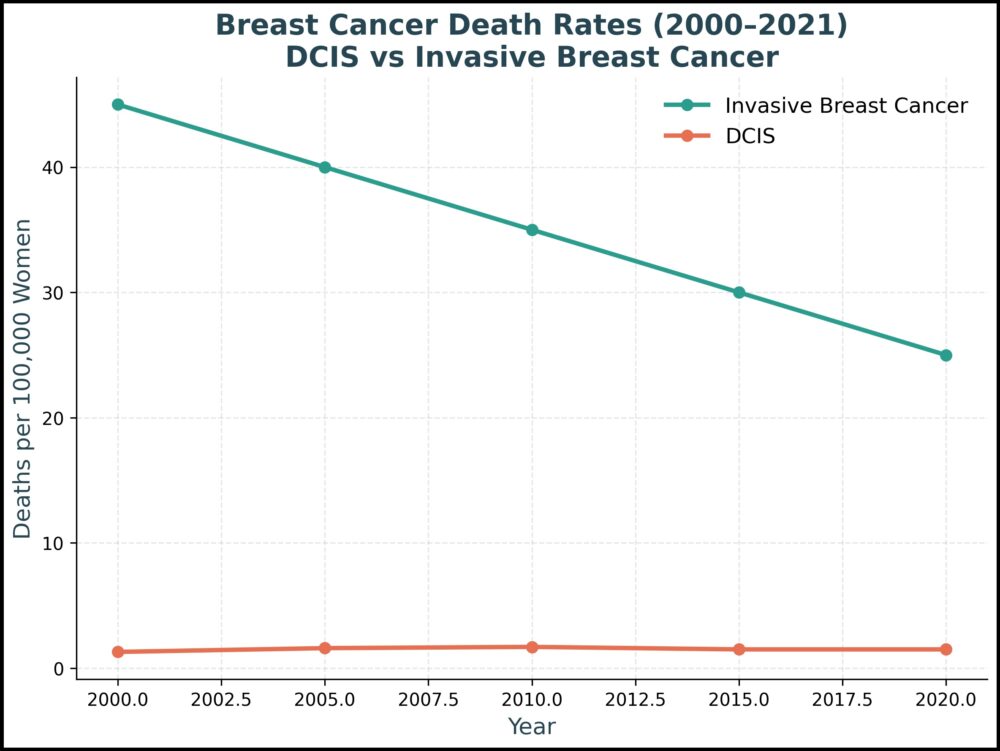
Are Death Rates from Breast Cancer After Initial DCIS Diagnosis Going Down? A New Study Raises Questions
When we talk about progress in breast cancer, we often point to the encouraging news that deaths from invasive breast cancer have steadily declined over recent decades—thanks to advances in detection, treatment and care.
But for DCIS, there is weak or even no evidence that our current treatments actually reduce the chance of dying from breast cancer. A new study published in Breast Cancer Research looked closely at this question, and the results raise important concerns.
-
September 29, 2025
A New Clue to Why Some DCIS Becomes Invasive Cancer
One of the biggest questions for people diagnosed with DCIS is: which cases will stay harmless inside the milk ducts, and which ones will progress to invasive breast cancer?
A new study from researchers in Finland and Sweden offers an important piece of this puzzle. They discovered that a protein called HSF2 may act like a “switch” that helps determine whether cells stay put in the ducts or begin invading surrounding breast tissue.
-
September 3, 2025

Dutch Study Brings Reassuring News About Long-Term Outcomes for DCIS Patients
A new study from the Netherlands offers encouraging news for women diagnosed with ductal carcinoma in situ (DCIS). Researchers followed nearly 19,000 women diagnosed between 1999 and 2015 and looked at how many went on to die of breast cancer over the next decade. The results may surprise you: only about 1.3% of women died from breast cancer within ten years of their DCIS diagnosis. This suggests that, while DCIS carries some risk, the vast majority of women will not die of breast cancer in the decade following their diagnosis. The study also compared women with DCIS to the general population….
-
July 18, 2025

Is It Safe to Wait? What a New Study Says About Delaying Surgery for DCIS
When you’re told you have ductal carcinoma in situ (DCIS), the instinct is often to treat it quickly and aggressively. But what if some DCIS doesn’t need immediate surgery at all? A new study published in The BMJ (British Medical Journal) suggests that for some women, delaying surgery and monitoring may be a safe option. In this observational cohort study, researchers followed 1,780 women across the U.S. who were diagnosed with DCIS but chose not to have surgery within the first six months of diagnosis. The goal was to understand how many later developed invasive breast cancer and how many died from…
-
July 10, 2025

Endocrine Therapy for 2+ Years May Be as Effective as Radiation for Some DCIS Patients
Ductal carcinoma in situ (DCIS) is often found through screening before it has a chance to spread. While this sounds reassuring, it leads to a tough question: how much treatment is enough? Most DCIS patients undergo surgery, often followed by radiation and/or hormone (endocrine) therapy. But not all DCIS is aggressive, and over-treating low-risk cases can cause unnecessary side effects. This new study, published in NPJ Breast Cancer, takes a fresh look at how long endocrine therapy needs to be taken—and whether it might offer similar protection as radiation. Researchers analyzed 1,916 patients from two large California cancer centers, with a…
-
June 11, 2025

Could a Menopause Drug Help Prevent Invasive Breast Cancer? A New Study Offers Hope for DCIS Patients
A recent Phase 2 clinical trial led by Northwestern Medicine suggests that Duavee, a medication already FDA-approved to treat menopause symptoms, might also help prevent invasive breast cancer in some women diagnosed with ductal carcinoma in situ (DCIS). The study, led by Dr. Swati Kulkarni, a breast surgeon and professor at Northwestern University Feinberg School of Medicine, was presented on June 1 at the American Society of Clinical Oncology (ASCO) Annual Meeting in Chicago. What Was the Study About? The trial included 141 postmenopausal women with estrogen receptor-positive (ER+) DCIS, a type of early-stage breast condition that may sometimes lead to invasive cancer. Participants were randomly assigned…
-
May 5, 2025

Study Finds No Clinical Benefit in Re-Excising Narrow Margins After Lumpectomy for ER+ Postmenopausal DCIS
A phase 3 clinical trial (NSABP B-35 (NCT00053898)) has found that margin widths of 1 mm vs 2 mm after lumpectomy in postmenopausal women with estrogen receptor–positive (ER+) DCIS do not result in clinically meaningful differences in rates of ipsilateral breast tumor recurrence (IBTR). The findings were presented at the American Society of Breast Surgeons conference by Dr. Irene Wapnir of Stanford Medicine. The trial included over 3,100 postmenopausal women with ER+ DCIS, all of whom received whole-breast irradiation and 5 years of hormone therapy (tamoxifen or anastrozole) after lumpectomy. Looking at 10-year rates of IBTR, the study found that rates were similar regardless of whether surgical margins…
-
April 15, 2025

Personalized Care for DCIS: New Genetic Score Offers Hope
While most cases of DCIS stay harmless, some can eventually turn into invasive cancer, which is harder to treat. Right now, it’s difficult for doctors to predict which DCIS cases are likely to progress, often leading to overtreatment with surgery or radiation for many women. A new study published in Cell Death Discovery aimed to find a better way to predict which DCIS cases might turn aggressive and threaten a patient’s health. In the study, researchers looked very closely at thousands of individual breast cancer cells from patients at different stages of disease. They identified nine important genes that behave differently in invasive versus non-invasive cells. Using these…
Subscribe below for the latest DCIS news and updates.